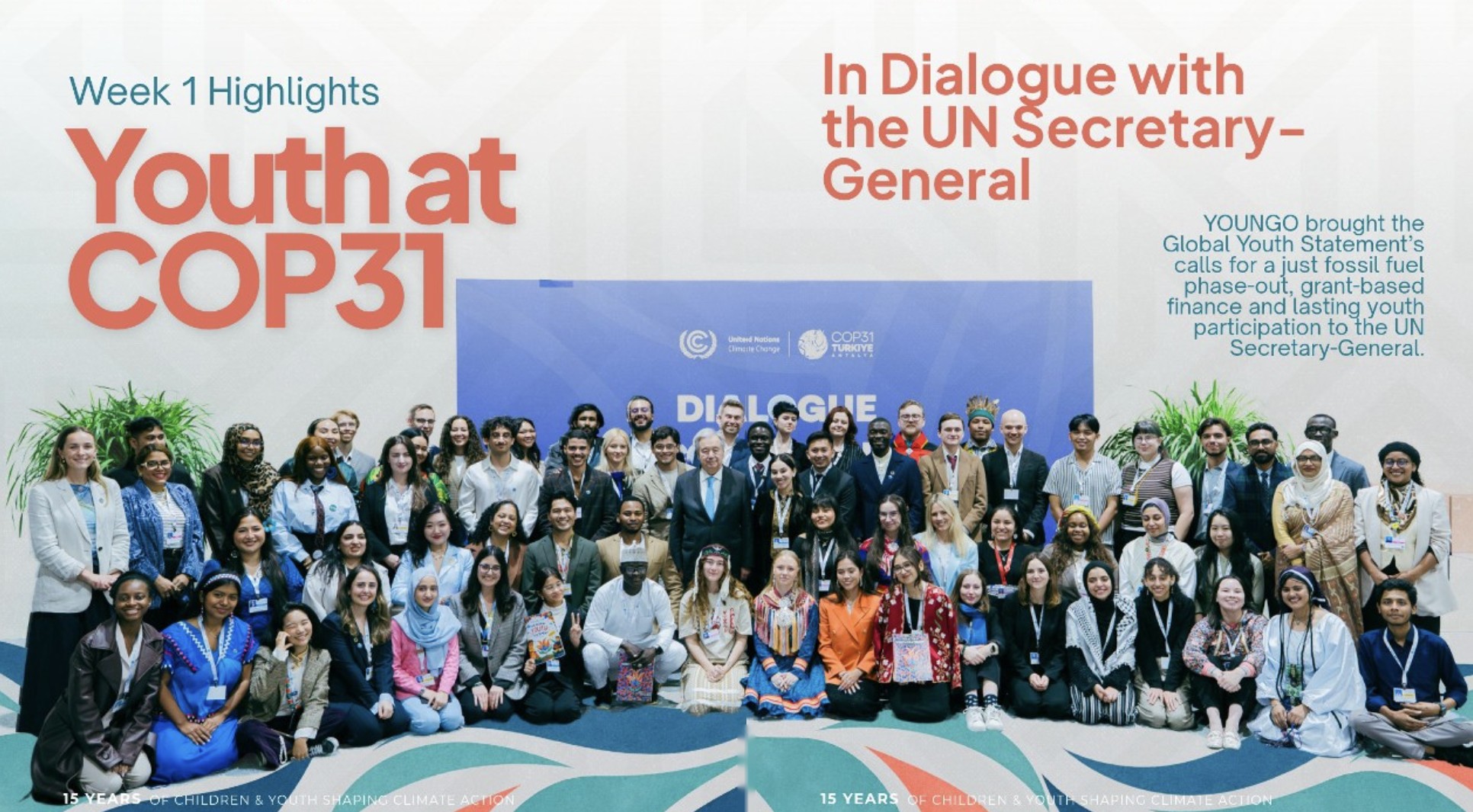
Youth advocates brought community evidence and policy demands into two weeks of climate talks in Antalya. The breakdown leaves urgent questions about finance, livelihoods and accountability for Africa unresolved.
The UN Climate Change Conference (COP31) closed in Antalya, Türkiye, on 22 November without agreement on an overarching political outcome, after talks extended beyond their scheduled 9–20 November dates. For African young people who had pressed for accessible climate finance and a stronger role in decisions, the conference ended with a substantial part of their agenda unfinished.
The United Nations confirmed the absence of an overarching agreement. Disagreements over fossil fuels and climate finance were central to the breakdown. Some negotiating decisions were adopted, including on just transition, as UN Climate Change Executive Secretary Simon Stiell acknowledged in his closing remarks. The failure lay in securing the wider political agreement intended to bring the conference together.
Global youth priorities enter the talks
The Global Youth Statement 2026 provided a common basis for youth advocacy. Coordinated by YOUNGO, the official children and youth constituency of the United Nations Framework Convention on Climate Change (UNFCCC), it drew on local and regional youth conferences, working groups and individual contributions.
Co-hosts of the 21st Conference of Youth (COY21), writing at the University of Melbourne, reported contributions from more than 100,000 children and young people worldwide. The statement brought together recommendations on adaptation, mitigation, finance and justice, alongside concerns about culture and meaningful participation. It was presented to the COP31 leadership following the Conference of Youth held before the negotiations.
The statement gave governments a set of proposals against which their responses could be assessed. Its presentation, however, did not make those proposals negotiated COP decisions. Their influence depended on governments taking them into negotiations and carrying them into national implementation.
The substance extended into particular sectors. YOUNGO’s Food and Agriculture Working Group statement called for direct, grant-based finance for youth and smallholder initiatives, protection for informal and seasonal rural workers, and stronger support for young farmers. These demands connected climate policy with access to land, food security and decent work.
Youth engagement continued across both weeks
The Youth-led Climate Forum programme organised discussion around just transition in food systems and oceans, Action for Climate Empowerment, and adaptation and loss and damage. These were entry points into active negotiating issues, including the financing and participation needed to turn climate commitments into practice.
On 14 November, the dedicated children and youth thematic day included the forum’s headline event. Its published design used a Youth–Negotiator Challenge Lab to develop practical proposals and identify where they could enter the COP process. The programme also provided for presentation of the Global Youth Statement to the UNFCCC leadership.
Engagement continued into the second week. The 16 November Presidency event on education, public awareness and children and youth addressed how climate science could inform public action. On 19 November, the Earth Negotiations Bulletin recorded YOUNGO calling for a rethink of the negotiating process during consultations on strengthening the UNFCCC.
By then, frustration was evident. In a 19 November account from the Children and Youth Pavilion, Pakistani climate advocate Sidra Riaz warned that “visibility is not influence”. Youth representatives questioned whether greater access to events and officials was changing decisions on adaptation finance and fossil fuels.
African positions focused on finance and public accountability
African youth organisations brought distinct national and continental positions to Antalya, with recurring demands for finance that reaches communities and participation that affects public decisions.
The Green Africa Youth Organization (GAYO), which co-organised the Regional Conference of Youth Africa, identified three priorities for its COP31 engagement: adaptation finance accessible to local organisations, trained young people within national delegations, and water at the centre of adaptation. Its published programme connected these priorities with informal waste workers, green enterprise, water stress and the ability of vulnerable communities to remain in their homes.
The African Youth Water and Climate Statement supplied evidence behind these demands. Developed through GAYO’s continental initiative, it drew on five regional consultations and a survey of 1,209 respondents in 51 African countries. Among survey respondents, 76% reported having no real say in water and climate decisions, while 29% had lost or were losing a water-dependent livelihood. These findings describe participants’ experiences rather than population estimates for all African youth.
The statement sought maintained water and sanitation services, accessible early warnings, support for youth initiatives and formal responses to youth recommendations. It also called for loss and damage finance to recognise water-dependent livelihoods.
South Africa’s youth statement, convened through Youth@SAIIA, the youth programme of the South African Institute of International Affairs (SAIIA), before COP31, similarly demanded public tracking of climate expenditure and results, youth involvement in allocating and monitoring finance, and clearer pathways into green employment. Its proposals included teacher preparation for climate education and practical training for young farmers.
In West Africa, YOTA’s earlier reporting on six national youth processes documented demands for youth climate funds, community scrutiny of adaptation budgets and more inclusive decision-making. These positions gave the wider debate a specific domestic focus: who receives support, who decides and how delivery is monitored.
Initiatives advanced while the political agreement failed
The two weeks produced developments that remain relevant despite the breakdown. On 13 November, Presidency Youth Climate Champion Sally Higgins launched Back Future Farmers, a campaign to bring together financing and market approaches that help young farmers develop sustainable, commercially viable businesses.
The UNFCCC’s Global Climate Action Yearbook also records the launch, with the United Nations Children’s Fund (UNICEF), of an annual Antalya High-Level Dialogue on Children, Youth and Climate Resilience. Its inaugural discussion addressed electrification and barriers to skills and participation in emerging energy transitions.
The Commonwealth Youth Negotiations Fellowship offers another route into sustained engagement, combining mentorship with practical experience. Its six participating countries include Botswana, Nigeria and Seychelles.
These initiatives create opportunities for follow-up. Their value will depend on the support they deliver and the opportunities young people can actually access. They do not replace the wider agreement governments failed to secure.
What the breakdown means for African youth
The immediate setback is the lost opportunity to strengthen collective delivery on finance and emissions reductions. Reuters’ account of the closing negotiations identified disputes over fossil fuels and finance, including the absence of a defined baseline for proposed increases in adaptation support.
For young farmers, coastal communities and informal workers, uncertainty over finance risks prolonging the gap between identifying climate threats and funding responses. Training, resilient infrastructure and social protection require predictable support. A conference breakdown cannot establish the fate of individual projects, but it adds pressure to an already difficult effort to secure resources.
The outcome also intensifies the question of whose participation counts. At the closing stages, the African Group of Negotiators criticised the handling of Action for Climate Empowerment and long-term finance. Those governmental concerns were distinct from youth positions, but both raised questions about whether contributions were meaningfully considered.
Existing commitments and institutions continue. The task now is to pursue implementation through national climate plans, public budgets and established finance mechanisms, while pressing for stronger international cooperation. Youth organisations have a basis for doing so in the positions, evidence and monitoring proposals they developed before and during Antalya.
Through the Africa Youth Partnership, with Ford Foundation funding, YOTA supported participation by Youth Task Team members from The Gambia, Ghana, Liberia, Nigeria, Senegal and Sierra Leone. Their forthcoming accounts will help establish which proposals they advanced, what responses they received and where follow-up is possible.
The next measure of progress must be visible in the communities those delegates represent: resources reaching local initiatives, livelihoods receiving protection and young people influencing the decisions that shape climate action.
Photo: Youth participants with UN Secretary-General António Guterres at COP31, Antalya, Türkiye, November 2026. Image credit: YOUNGO.
This story was first published on the Africa Youth Partnership website.