

Evidence from Microsoft and Anthropic data, with a focus on Ghana, Nigeria, Kenya, Egypt and South Africa

By Emmanuel Edudzie
Executive Director, YOTA
Summary
Generative AI reaches fewer people in most African countries than elsewhere, and more of the use that does happen is for coursework. As in the first note, Senegal is not a focus country because its survey does not classify most occupations; it appears in the unemployment analysis of the third note in this series.
- Adoption is low. In the second quarter of 2026, about 1 in 10 people aged 15–64 used a generative AI product in Ghana (10.4%), Nigeria (10.4%) and Kenya (8.9%), against 18.8% worldwide. South Africa (23.9%) is the only African country above the world figure.
- Claude follows the same pattern. Claude use per working-age person is below the world average in 24 of the 26 African countries with published data. Countries rank much the same on Claude use as on Microsoft’s adoption measure.
- Coursework takes twice the world share. In the median African country, 32% of Claude conversations are coursework, against 16% worldwide. In Ghana the figure is 36%.
- More handing over, a little less learning. In the median African country, 39% of conversations hand a task to Claude to complete, against 32% worldwide. 15% seek to understand something, against 17%.
- The pattern is about low use, not about Africa. Across 121 countries, the less a country uses Claude, the larger the coursework and hand-over shares. Microsoft and Anthropic have reported similar patterns in their own data.
Why this matters
The first note in this series, How exposed are young people’s jobs in Africa to generative AI?, found that few young workers in Ghana, Nigeria, Kenya, Egypt and South Africa hold exposed jobs. The exposure that exists sits mainly in clerical work.
Exposure measures what AI could do to a job’s tasks. It says nothing about who uses AI today, or for what. This note turns to actual use.
Who uses AI first shapes where its benefits and risks land. If many early users are students, AI is reaching young people through education before it reaches their jobs. How they use it while learning will affect the skills they bring to work.
Data and method
Two open datasets answer the two questions. The five focus countries are the same as in the first note.
| Question | Source | Measure | Coverage |
|---|---|---|---|
| How many people use AI? | Microsoft AI Diffusion data, Q2 2026 | Share of people aged 15–64 who used a generative AI product, from anonymised Microsoft telemetry adjusted for device market share, internet use and population | 147 economies, 46 of them African |
| What do they use it for? | Anthropic Economic Index, release of 26 June 2026 | What a privacy-preserving sample of Claude.ai conversations is for, and how people work with Claude | April and May 2026; 121 countries, 26 of them African |
The Anthropic measures used here:
- Usage per capita index. A country’s share of Claude conversations divided by its share of the world’s working-age population. 1 means use in proportion to population.
- Use case. Each conversation is classed as work, personal or coursework.
- Collaboration mode. Directive means handing a task to Claude with little back-and-forth. Learning means asking for understanding or explanation rather than a finished product. Three other modes cover iteration, feedback and checking one’s own work.
- Request category. The broad kind of help asked for, such as Education & Learning or Content Creation & Copywriting.
Where both months are published, they are averaged. Cross-country patterns use the Spearman rank correlation across all 121 countries.
Claude is a small part of AI use in most African countries, so its data describe Claude users, not all AI users. It is used here because Anthropic publishes, country by country, what people use its product for. Microsoft’s report notes that studies of Bing Copilot, Gemini and Claude all find coursework a larger part of AI use in lower-income countries.
Few people use AI yet, outside South Africa
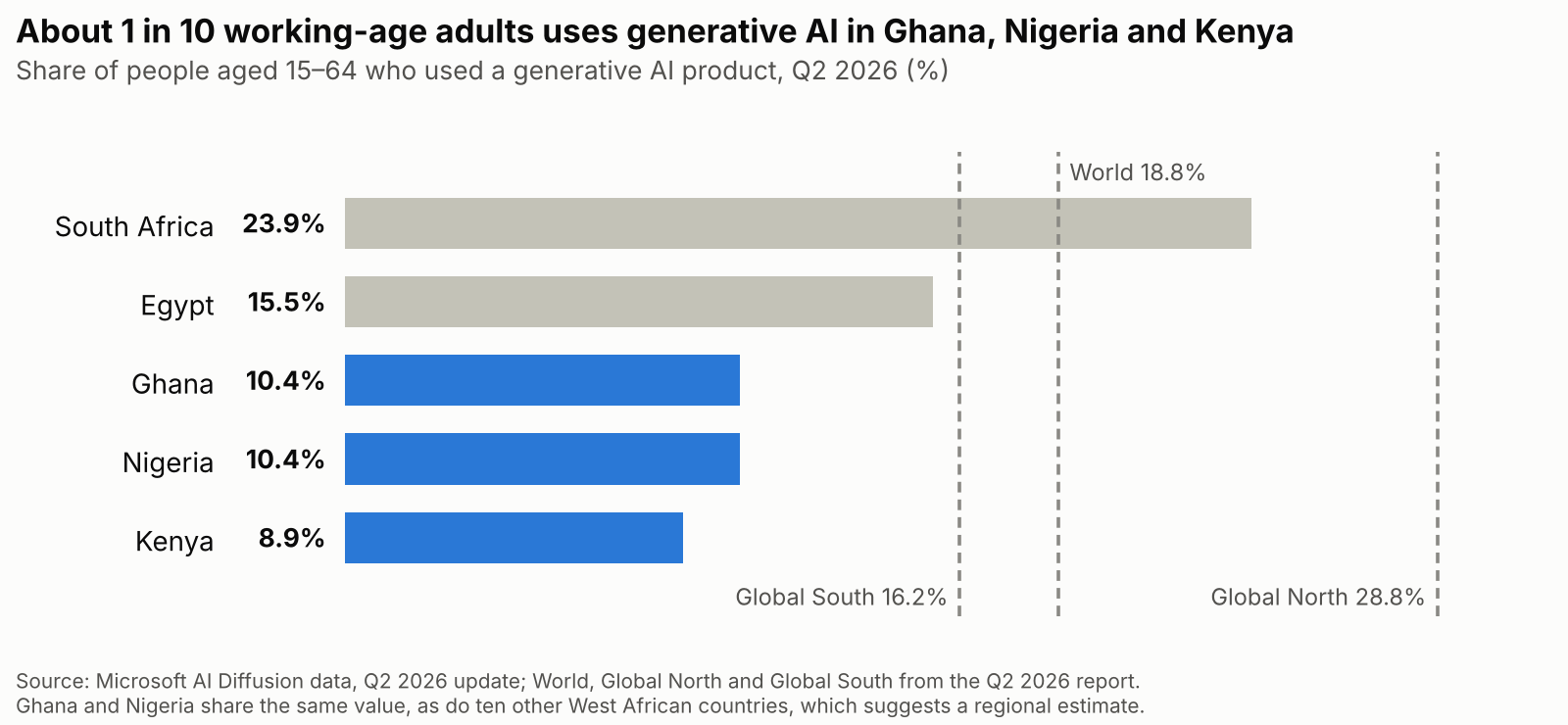
Adoption in Ghana, Nigeria and Kenya is about half the world level. South Africa is above it, and Egypt is close to the Global South average.
The gap is widening. Between the first and second quarters of 2026, adoption rose by 0.2–0.3 percentage points in Ghana, Nigeria and Kenya, against 1.0 point worldwide.
Claude use is low in almost every African country
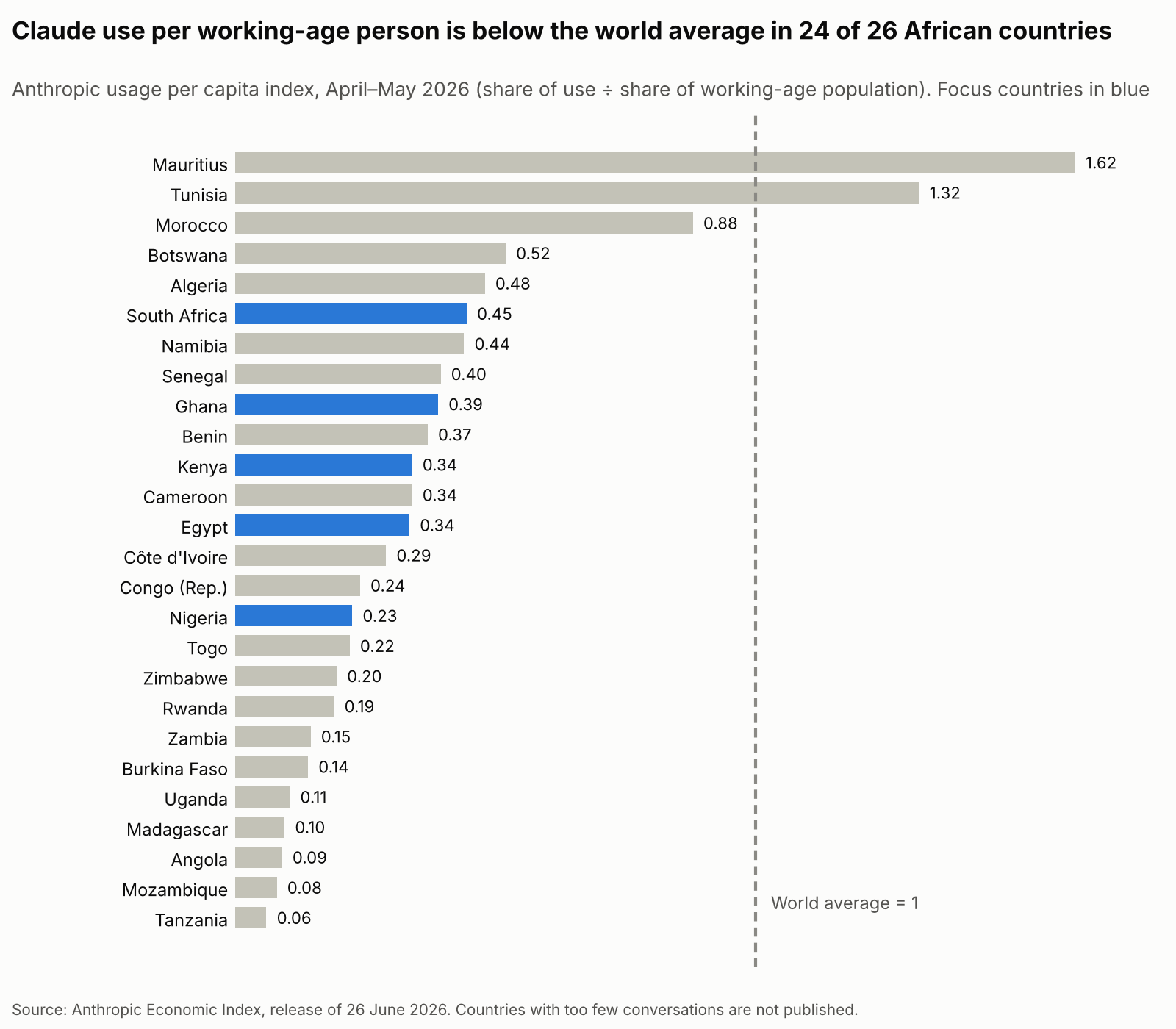
Only Mauritius and Tunisia use Claude more than their working-age population would predict. In Ghana, use per working-age person is about two-fifths of the world average; in Nigeria, under a quarter.
Countries rank much the same on Claude use as on Microsoft’s adoption measure (rank correlation 0.86 across 109 countries). So although the Claude data come from one product, they track wider AI adoption.
Where use is rarer, coursework takes a bigger share
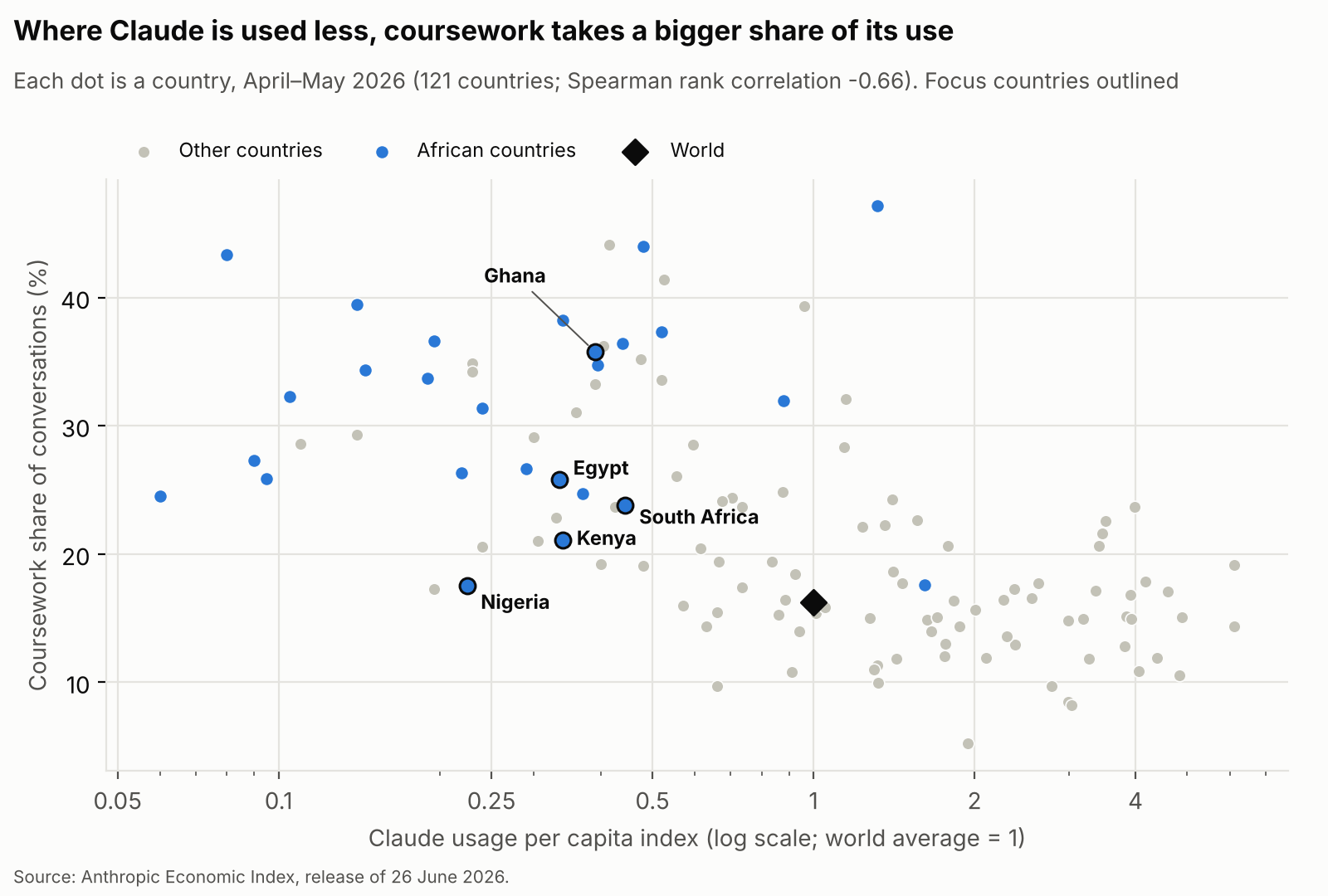
Across 121 countries, the lower a country’s Claude use, the larger the share that is coursework (rank correlation −0.66). Most African countries sit in the upper left: low use, high coursework. In the median African country, coursework is 32% of conversations, twice the world share of 16%.
The pattern goes beyond Claude. In Microsoft’s data on its Copilot assistant, schoolwork and academic support take a share about a third larger in the Global South than worldwide. Microsoft suggests the South’s younger population is part of the reason.
Nigeria is the exception among the focus countries: coursework is 18% of its conversations, close to the world share.
More handing over, a little less learning
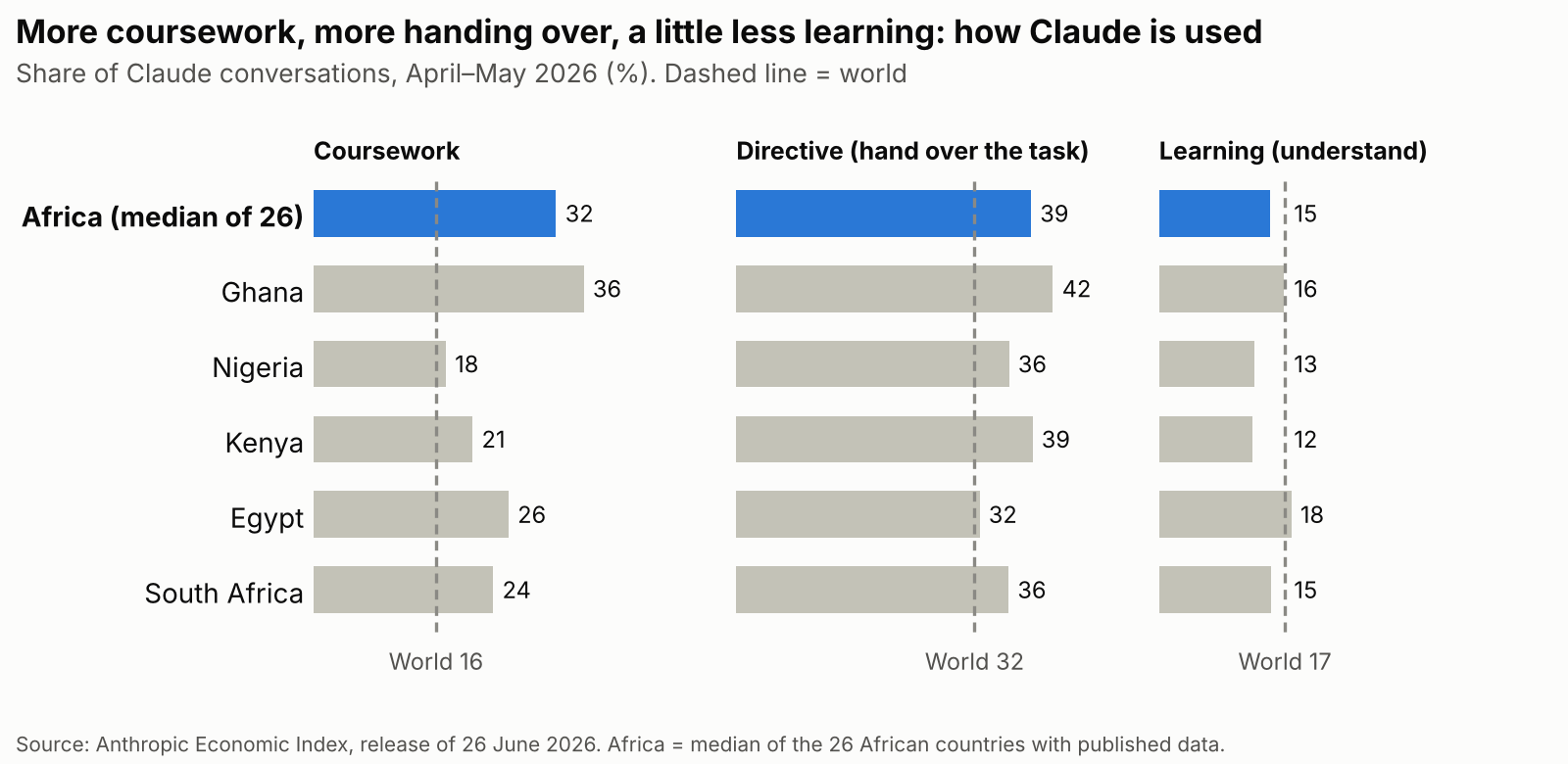
In the median African country, 39% of conversations are directive, against 32% worldwide, and 15% are learning, against 17%. Anthropic’s January 2026 report found the same tilt across all countries: higher-use countries automate less and collaborate more.
Ghana stands out, with the highest coursework (36%) and directive (42%) shares of the five. Egypt is the one focus country close to world levels on both directive and learning use.
What people ask Claude for also differs. Ghana’s requests lean to education, Nigeria’s to content creation and copywriting, and Egypt’s to software development.
| Request category (% of requests) | World | Ghana | Nigeria | Kenya | Egypt | South Africa |
|---|---|---|---|---|---|---|
| Content Creation & Copywriting | 22.2 | 25.6 | 38.4 | 28.6 | 19.0 | 23.6 |
| Education & Learning | 12.9 | 28.9 | 14.8 | 16.8 | 19.2 | 19.4 |
| Software Development | 11.8 | 12.0 | 13.0 | 15.8 | 20.3 | 12.0 |
| Research & Intelligence | 10.7 | 6.1 | 6.6 | 7.1 | 7.6 | 8.4 |
Source: Anthropic Economic Index, release of 26 June 2026, top-level request categories, average of April and May 2026. The four largest categories worldwide are shown.
What this means for education and youth employment
In these countries AI is reaching young people through education before it reaches their jobs.
- Education is the front door. In Ghana, 29% of Claude requests are for education and learning, more than twice the world share (13%). Schools and universities are where guidance on using AI well will reach most young users.
- Learning, not only finishing. Where use is low, more conversations hand the task over and fewer seek explanation. The data cannot show whether coursework itself is handed over. Even so, assessment that rewards the process, and teacher training in AI-assisted learning, would help students build skills rather than only complete assignments.
- Access first. With adoption at about 1 in 10 in Ghana, Nigeria and Kenya, most young people are not yet users. Devices, data costs, electricity and skills decide who joins, and early gaps can widen.
- From classroom to work. Few of today’s youth jobs are exposed, but today’s students will carry their AI habits into work. Employers and training providers should expect graduates who already use AI, unevenly and often to finish tasks.
- Better data. More AI companies should publish country-level usage data openly. National statistics offices could add questions on AI use, by age and education, to labour force and household surveys.
Limitations
- One product for “what for”. The Anthropic data cover Claude only, a small share of AI use in most African countries. Microsoft’s figures cover more products but do not say which.
- Regional estimates. 29 of the 46 African economies in Microsoft’s data share one of just four values. Ghana and Nigeria are among 12 West African economies at exactly 10.4%, so differences between them should not be read into.
- Patterns, not causes. The coursework, directive and learning shares are separate country-level measures. They do not show how coursework conversations themselves go, and the correlations do not show causes. Younger populations are likely part of the story, as Microsoft notes for the Global South.
- Automated classification. Claude itself classifies the conversations, so some will be misclassified.
- Two months. April and May include exam periods in some countries, which may raise the coursework share.
- Published cells only. Countries with too few conversations are not published, so the African picture covers 26 mostly larger and better-connected countries. Five of them have one month of data only.
How AI was used. This analysis was produced with Claude, an AI model made by Anthropic, under the author’s direction. The author is responsible for the content.
Role. The author set the question, decided the method, and approved the sources and countries. Claude wrote the Python code and drew the charts.
Conflict of interest. Claude is made by Anthropic, whose data are one of the two sources, and the findings describe how people use Claude. To limit bias, adoption figures come from Microsoft, and the Claude patterns are checked against Microsoft’s figures and its own findings for Copilot. The analysis reports Claude’s low reach in Africa alongside its uses.
Verification. Every headline figure was recomputed by a separate script that reads the raw files directly. Microsoft’s regional figures were checked against its report. The global patterns match those Anthropic reported in January 2026 and Microsoft in September 2026.
Limitations. AI-written code can contain errors that checks miss. The notebook and data extract are published so that anyone can rerun the analysis.
Sources, data and code
- Microsoft AI Economy Institute (2026). Global AI Diffusion Q2 2026 Trends and Insights. September 2026. Data: AI_Diffusion_Q22026_Update.csv.
- Misra, A., Wang, J., McCullers, S., White, K. and Lavista Ferres, J. (2025). Measuring AI Diffusion: A Population-Normalized Metric for Tracking Global AI Usage. arXiv:2511.02781.
- Anthropic (2026). Anthropic Economic Index report: Cadences. 26 June 2026. Data: Anthropic/EconomicIndex, release_2026_06_26, CC-BY.
- Appel, R., Massenkoff, M., McCrory, P. and others (2026). Anthropic Economic Index report: Economic primitives. Anthropic, 15 January 2026.
The Python notebook, data and charts behind every figure here: download the code and data (zip).
More in this series: How exposed are young people’s jobs in Africa to generative AI? and The graduate squeeze: young graduates, unemployment and AI in Africa.