
Evidence from Ghana, Nigeria, Kenya, Egypt, Senegal and South Africa

By Emmanuel Edudzie
Executive Director, YOTA
Summary
In five of six African countries, young graduates are the most likely young people to be unemployed, and those in work hold the jobs where generative AI exposure is concentrated.
- Graduates wait longest for work. Among 25–34-year-olds, graduates are more likely than their peers to be unemployed in Ghana (10.7% against 4.4%), Nigeria (16.9% against 5.9%), Egypt, Kenya and Senegal. South Africa is the exception.
- Women graduates in Egypt fare worst. 31% of women graduates aged 25–34 are unemployed, against 11% of men.
- Graduates hold the office jobs. 57% of employed graduates in Ghana work in clerical, professional or technical jobs, against 8% of all workers. Across five countries, graduates are 2.5 to 7 times as likely as the average worker to hold these jobs.
- Many work below their level. In Nigeria, 63% of employed graduates work in occupations that do not usually require tertiary education. In Ghana, 40% do.
- Generative AI adds to the squeeze. It arrives in the occupations graduates aim for, at a time when many already struggle to find them.
Why this matters
The first two notes in this series looked at the two ends of the transition from school to work. The first found that few young workers hold jobs exposed to generative AI, and that exposure sits in office work. The second found that much early AI use in African countries is coursework.
This note looks at the people in between: young graduates. They make up a sizeable share of young workers, from 8% of employed 25–34-year-olds in Kenya to 26% in Egypt. Many governments and families invest in tertiary education as the route to formal, office-based work. If graduates already struggle to find that work, and AI changes it, the return on that investment is at stake.
Data and method
The note uses three ILOSTAT datasets for the latest survey year in each country: Ghana 2025, Nigeria 2025, Kenya 2021, Egypt 2024, Senegal 2025 and South Africa 2025.
| Dataset | Used for |
|---|---|
| Unemployment rate by sex, age and education | Graduate unemployment, ages 15–24 and 25–34 |
| Employment by sex, age and education | Graduates’ share of young workers |
| Employment by sex, occupation and education | Where employed graduates work (all ages) |
- Graduates are people with advanced education in the ILO’s aggregate levels, which is tertiary education (ISCED 2011 levels 5–8). A check in the notebook confirms that the detailed levels add up to this aggregate.
- Ages 25–34 are the main measure for young graduates, because few 15–24-year-olds have finished tertiary education.
- Exposure tiers are the same as in the first note, based on the ILO’s 2025 index: clerical support is the high tier; professionals and technicians are mixed (finance, ICT and media exposed; teaching and health not).
- Below graduate level follows the ILO’s standard measure. Occupation groups 4–9 (skill levels 1–2) do not usually require tertiary education, so a graduate working in them counts as working below their level.
- Senegal is left out of the occupation analysis, because 65% of its workers’ occupations are unclassified. South Africa reports the older ISCO-88 occupation groups.
Young graduates are more likely to be unemployed
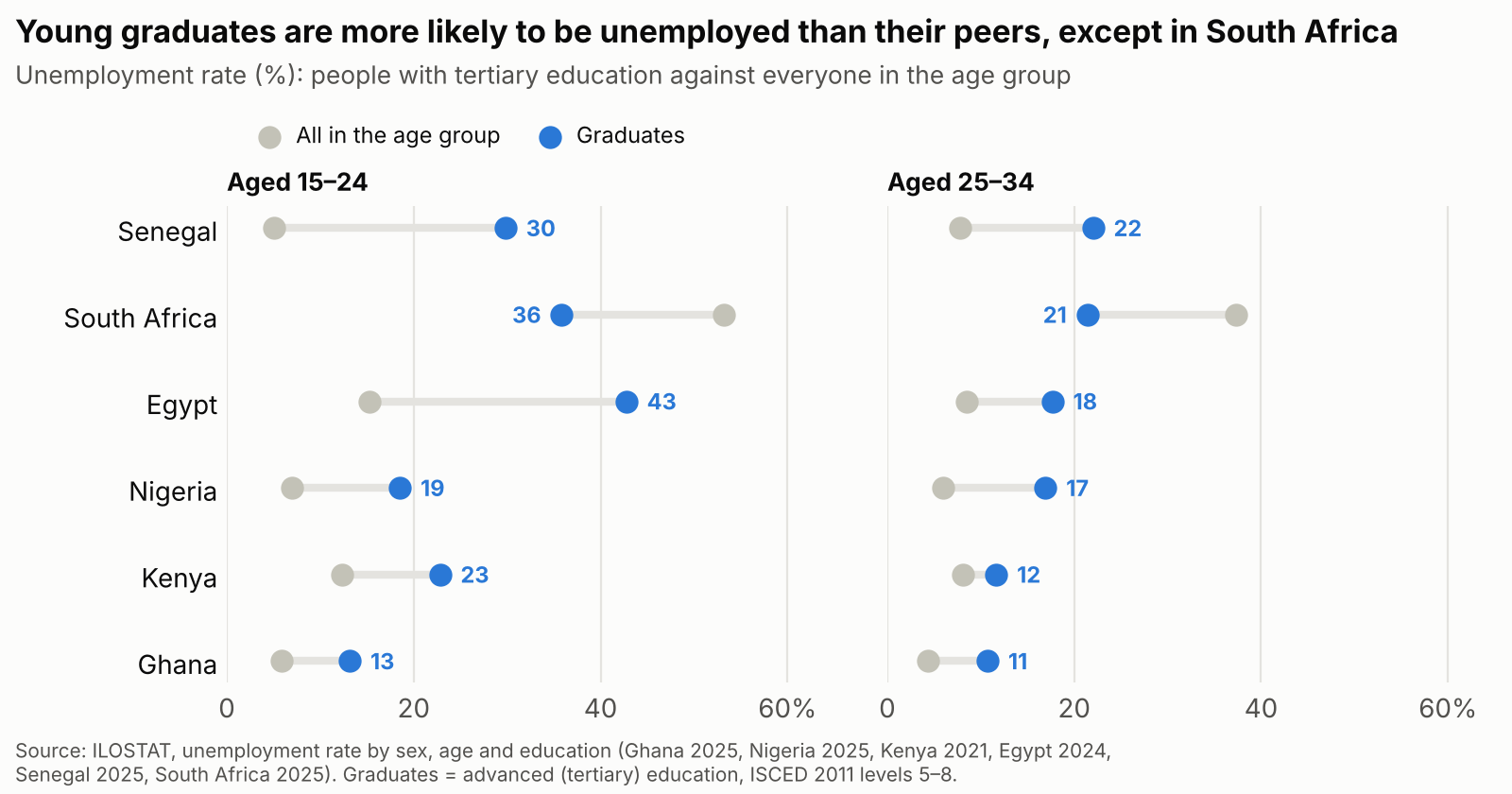
Among 25–34-year-olds, graduates’ unemployment rate is two to three times their peers’ in Ghana, Nigeria, Egypt and Senegal, and 1.5 times in Kenya. The gap is wider at 15–24: in Egypt, 43% of graduates in the labour force are unemployed.
Women graduates fare worst in Egypt: 31% of those aged 25–34 are unemployed, against 11% of men.
South Africa is the exception. Unemployment is very high for everyone there, and graduates do best. A common explanation for the pattern elsewhere is that where most work is informal and there are no unemployment benefits, people with little education cannot afford to stay unemployed. Graduates can wait longer for the formal jobs they trained for.
Graduates hold the office jobs where exposure is concentrated
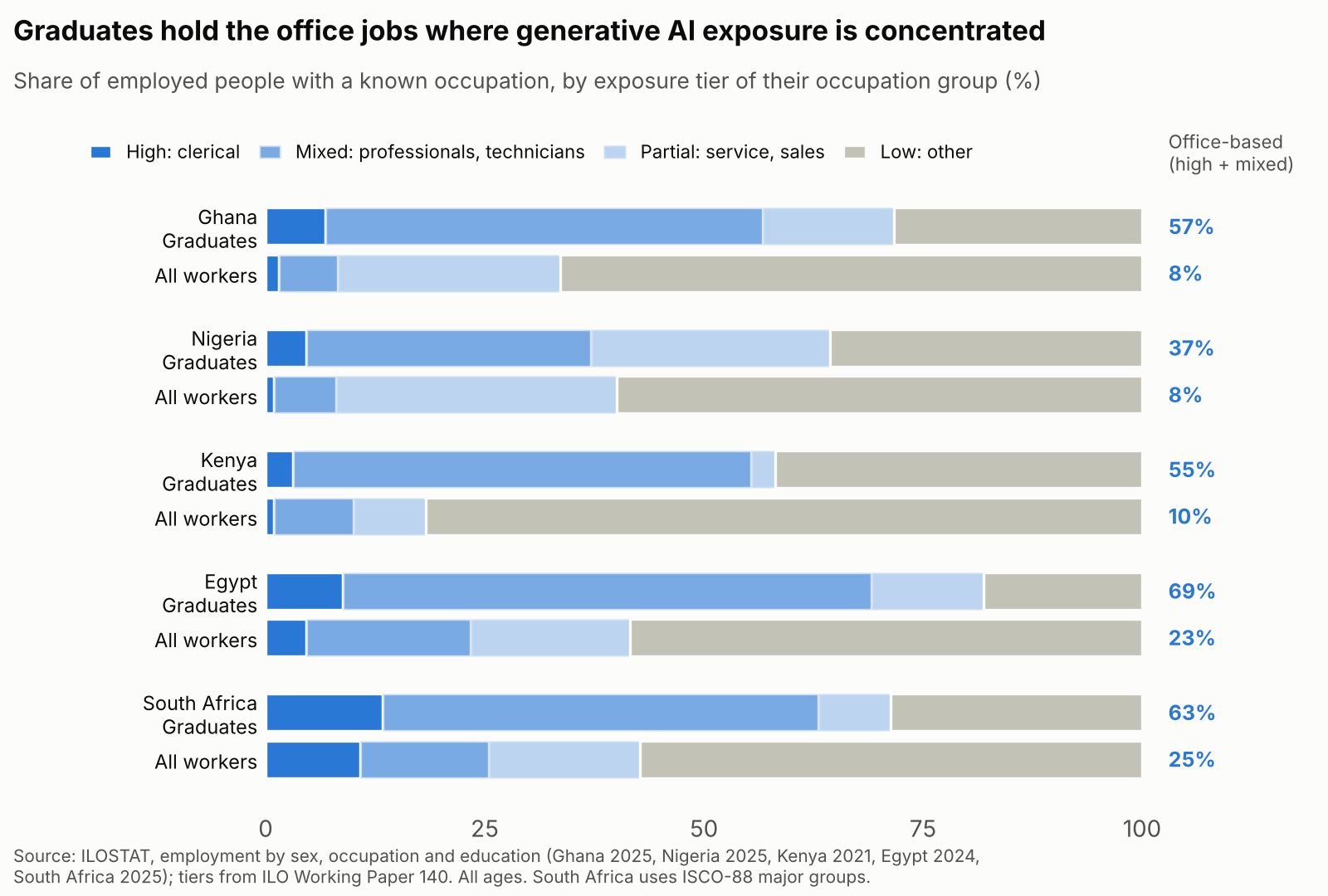
In Ghana, 57% of employed graduates work in clerical, professional or technical jobs, against 8% of all workers. Graduates are about 7 times as likely as the average worker to hold these jobs in Ghana, about 5 times in Kenya and Nigeria, 3 times in Egypt and 2.5 times in South Africa.
Most of this is professional and technical work. That includes exposed jobs in finance, ICT and media, but also teaching and health, which are not exposed. Clerical jobs, the most exposed, employ between 3% (Kenya) and 13% (South Africa) of graduates.
So graduates are where generative AI exposure is concentrated, even though many graduate jobs are not exposed.
Many graduates work below their level
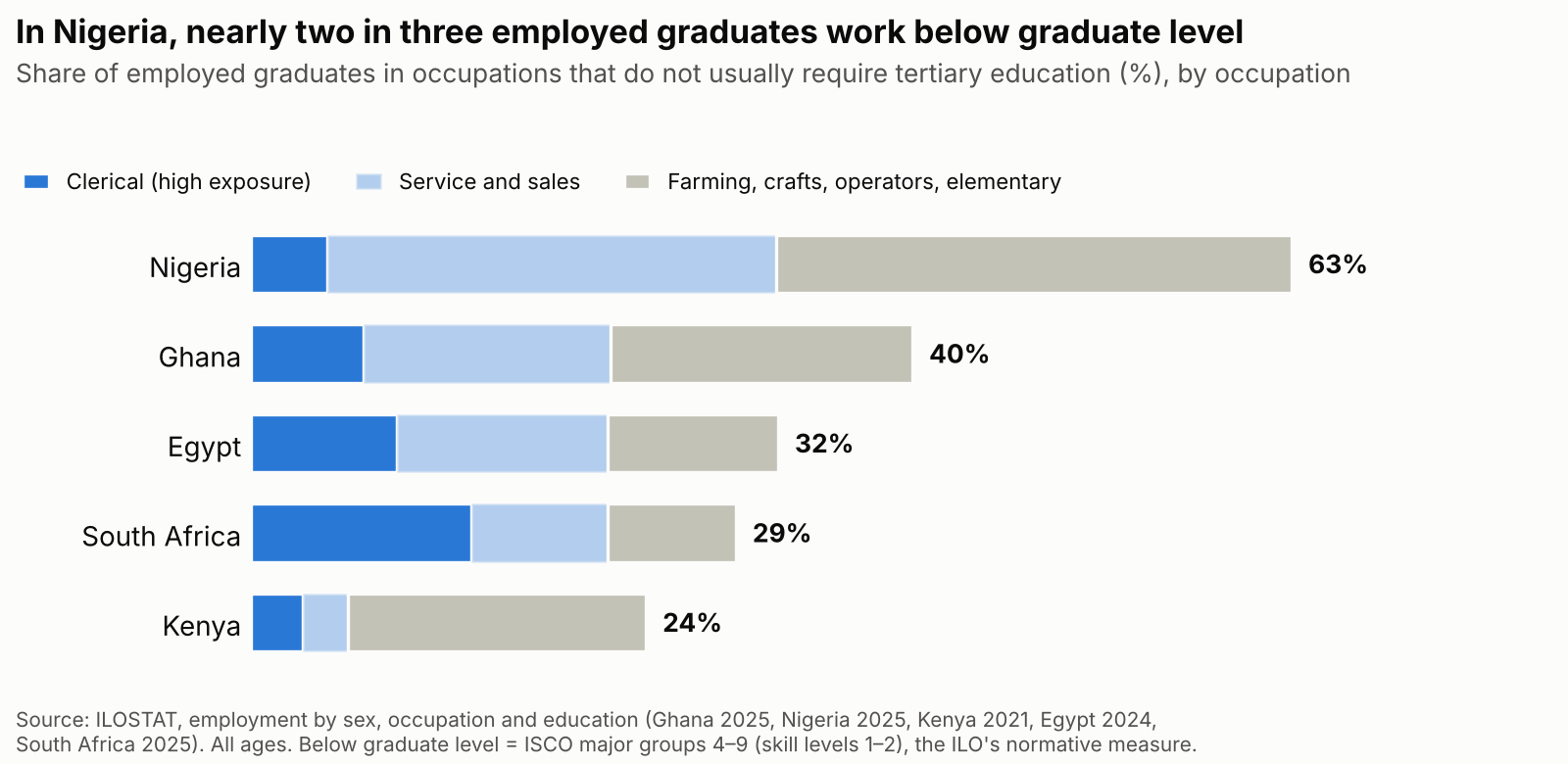
In Nigeria, 63% of employed graduates work in occupations that do not usually require tertiary education: 27% in service and sales, and 31% in farming, crafts, machine operation or elementary work. In Ghana the figure is 40%.
In South Africa, nearly half of the graduates working below their level are in clerical jobs, the most exposed tier.
Women and men differ. In Egypt, 16% of employed women graduates work below graduate level, against 38% of men. In Ghana and Nigeria, women graduates are slightly more likely than men to do so.
Graduates in trade and farming face little direct exposure to generative AI, but the skills their education built go largely unused.
What this means for education and youth employment
Generative AI did not create the graduate squeeze, but it lands on it.
- Prepare graduates for changing office work. Courses that lead to clerical, administrative, finance and ICT jobs train graduates for the most exposed occupations. They should teach AI-assisted work and the judgement, client and problem-solving skills that AI does not replace.
- Look beyond office jobs. In Nigeria and Ghana, many graduates already work in trade, farming and crafts. Skills that raise productivity in those jobs, including digital and business skills, matter as much as preparation for office work.
- Watch women graduates. In Egypt, nearly a third of women graduates aged 25–34 are unemployed, three times the rate for men.
- Measure the squeeze. Labour force surveys should publish occupation by education and age, so that young graduates’ outcomes can be tracked as AI spreads.
Limitations
- Occupation by education covers all ages. ILOSTAT does not publish it by age, so the occupation findings describe all employed graduates, not only young ones.
- Major groups only. Exposure varies within groups. Many graduate professionals are teachers and health workers, whose jobs are not exposed, so the office-based share is an upper bound on graduates’ exposure.
- Exposure is not job loss. The tiers measure what generative AI could do to tasks, not what it will do.
- Unemployment is a narrow measure. It leaves out graduates who have stopped looking for work, and those in informal or part-time work below their skills.
- Survey differences. Years, surveys and classifications differ: Kenya’s data are from 2021, and South Africa uses ISCO-88. Comparisons between countries are approximate.
- Small samples. Few 15–24-year-olds have tertiary education, so rates for that group are less precise. The split by sex uses ages 25–34 for that reason.
How AI was used. This analysis was produced with Claude, an AI model made by Anthropic, under the author’s direction. The author is responsible for the content.
Role. The author set the question, decided the method, and approved the sources and countries. Claude wrote the Python code and drew the charts.
Verification. Every headline figure was recomputed by a separate script that reads the raw ILOSTAT files directly. The notebook also checks that the ILO’s “advanced” education level equals the sum of ISCED levels 5–8, and lists every cell ILOSTAT flags as unreliable.
Limitations. AI-written code can contain errors that checks miss. The notebook and data are published so that anyone can rerun the analysis.
Sources, data and code
- ILOSTAT, Unemployment rate by sex, age and education (%), annual, downloaded 1 October 2026.
- ILOSTAT, Employment by sex, age and education (thousands), annual, downloaded 1 October 2026.
- ILOSTAT, Employment by sex, occupation and education (thousands), annual, downloaded 1 October 2026.
- Gmyrek, P., Berg, J., Kamiński, K., Konopczyński, F., Ładna, A., Nafradi, B., Rosłaniec, K. and Troszyński, M. (2025). Generative AI and Jobs: A Refined Global Index of Occupational Exposure. ILO Working Paper 140.
The Python notebook, data and charts behind every figure here: download the code and data (zip).